



When Biotechnology Reinvents Cancer Diagnosis and Treatment
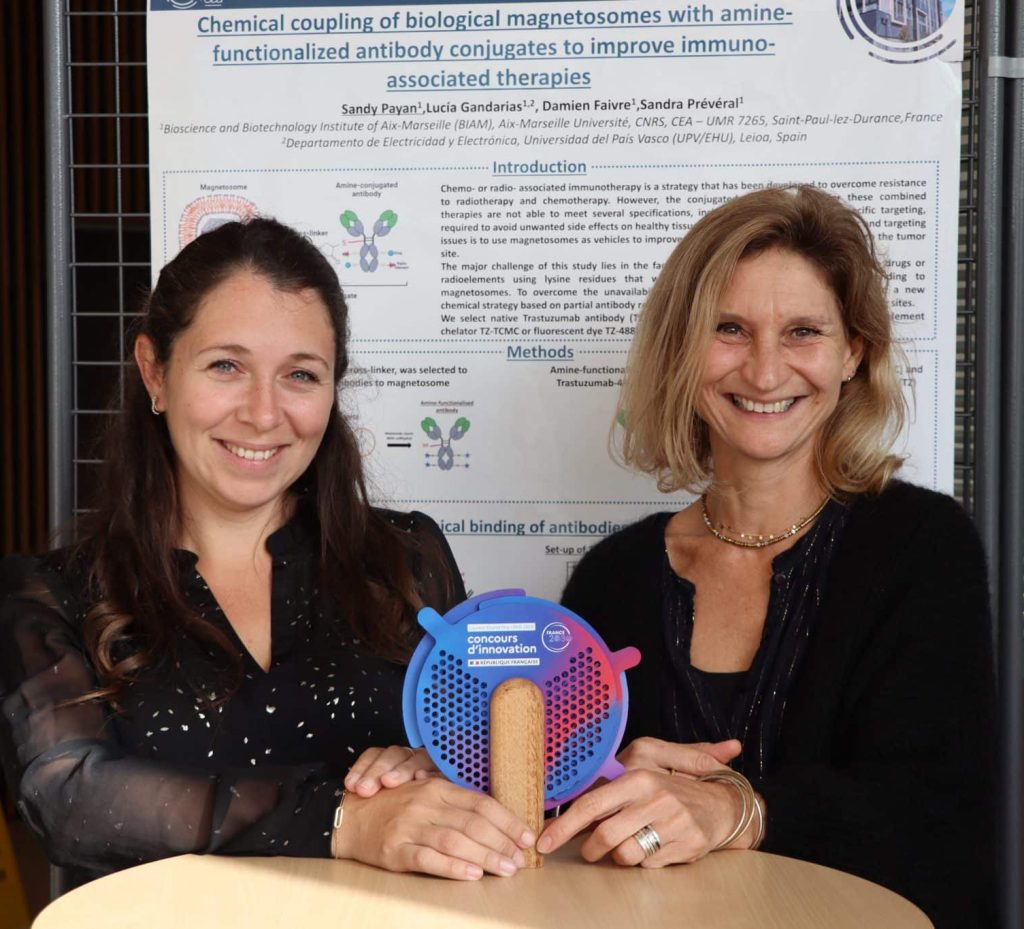
Each year, the Grand Prix i-PhD rewards young scientists whose innovations have the potential to become high-impact start-ups. This year, Sandy Payan, an engineer at BIAM, is among the laureates with MTBiocare, a groundbreaking iron nanoparticle technology that could transform the diagnosis and treatment of solid cancers. Her project promises a form of medicine that is more precise, safer, and environmentally friendly.
From Fundamental Research to Real-World Innovation
Sandy Payan began her career with a PhD in developmental biology, focusing on a protein candidate for cardiac regeneration, aiming to improve the lives of patients suffering from heart failure:
“I’ve always been driven by the desire to bridge fundamental research with tangible impact on human health,” she explains.
Together with Sandra Prévéral, research engineer at BIAM, she co-leads the MTBiocare project — a technology capable of revolutionizing both cancer diagnosis and therapy. Winning the Grand Prix i-PhD is a major strategic opportunity, offering guidance, mentorship, and national as well as European visibility.
Innovation: 20 Times More Powerful Particles
At the heart of MTBiocare are iron nanoparticles naturally produced by environmental bacteria — magnetosomes. These particles, which can be custom-engineered thanks to BIAM’s unique expertise in genetic engineering, are up to 20 times more powerful than the MRI contrast agents currently in use. They specifically target solid tumors and hold strong therapeutic potential:
“Our technology addresses three key challenges: (i) enabling earlier and more precise tumor diagnosis, (ii) optimizing treatment, and (iii) reducing the toxicity of gadolinium-based contrast agents,” explains Sandy Payan.
Medically, it paves the way for more personalized medicine. Environmentally, it offers an alternative to gadolinium — a rare metal whose extraction and increasing presence in aquatic environments pose serious ecological concerns.
Using iron instead of gadolinium provides a sustainable and strategic solution. This approach helps to:
- Reduce dependence on imported raw materials, notably gadolinium, which is mainly extracted in China
- Ensure a secure and long-term supply of contrast agents within the national territory
In today’s geopolitical context — marked by tensions around access to healthcare products and rare earth elements — developing iron-based contrast agents naturally produced by bacteria strengthens France’s industrial and health sovereignty, while ensuring continuous, safe, and eco-friendly production.
Beyond medical innovation, MTBiocare represents an ecological and sovereign solution, reducing reliance on rare earths and ensuring sustainable supply chains for healthcare centers.
Magellan: Turning Research into Market Value
Through the Magellan program, the two project leaders are strengthening their market understanding and entrepreneurial skills in preparation for creating a start-up. The next goals include advancing MTBiocare from proof of concept (TRL 3) to TRL 4/5, validating real-world demonstrations, securing regulatory aspects, and preparing for industrial scale-up.
“The program’s support allows us to transform this laboratory project into a viable start-up, while consolidating our network and paving the way for industrial and institutional partnerships,” says Sandy Payan.
For investors, MTBiocare represents a rare opportunity to support an innovation with high scientific and economic potential in a fast-growing field — personalized oncology.
Winning the Grand Prix i-PhD marks a major recognition of the scientific quality and potential of MTBiocare. The award provides Sandy Payan and her team with tailored mentorship, access to a network of innovation and funding experts, and increased national and European visibility. This distinction strengthens the project’s credibility with investors and industrial partners — paving the way for the creation of the start-up by 2027.
Contact sandy.payan@cea.fr
References
Mériaux et al., 2015- Advanced Healthcare Materials DOI.org/10.1002/adhm.201400756
Boucher et al., 2018- Biomaterials : DOI 10.1016/j.biomaterials.2016.12.013
Plan Sangnier et al., 2018- Journal of Controlled Release : DOI 10.1016/j.jconrel.2018.04.036
Preveral et al. 2020, Nanomedicine: Nanotechnology, Biology and Medicine DOI : 10.1016/j.nano.2019.102084
Payan et al. 2025, Journal of Chemical Technology & Biotechnology DOI : 10.1002/jctb.7878