



After twenty years of research on Deinococcus bacteria, renowned for their exceptional resistance to radiation and desiccation, BIAM celebrates an international recognition: the enzyme IrrE, an essential regulator of cellular survival under severe stress, has been included in the world reference book on peptidases. This chapter highlights the importance of fundamental research and opens new perspectives in microbiology, radiobiology, and biotechnology.
Twenty Years of Research on IrrE
At the invitation of editor Neil Rawlings, two BIAM researchers, Arjan de Groot and Laurence Blanchard, authored a chapter recounting twenty years of discoveries on the IrrE enzyme, from the characterization of the radiation-tolerant bacterium Deinococcus deserti in 2005—where it is present—to the full understanding of its mechanism of action, made possible by the identification of its substrate, the transcriptional repressor DdrO. This recognition symbolizes the culmination of a long-term effort involving also several PhD students and engineers, and highlights the functional uniqueness of IrrE, now considered the prototype of a new family of bacterial regulators involved in various stress responses.
A Key Enzyme for Extreme Resistance
Since its initial discovery in 2002 in Deinococcus radiodurans by an American team, and due to the work conducted at BIAM by these two scientists, IrrE has been recognized as an essential regulatory metallopeptidase for the cellular response to radiation and desiccation. The determination of its crystal structure in 2009 in collaboration with the IBS Grenoble, the discovery of its substrate, the DdrO repressor, in 2014, and the progressive elucidation of its molecular mechanism between 2017 and 2025 have positioned the IrrE/DdrO pair as a reference for a new family of bacterial regulators.
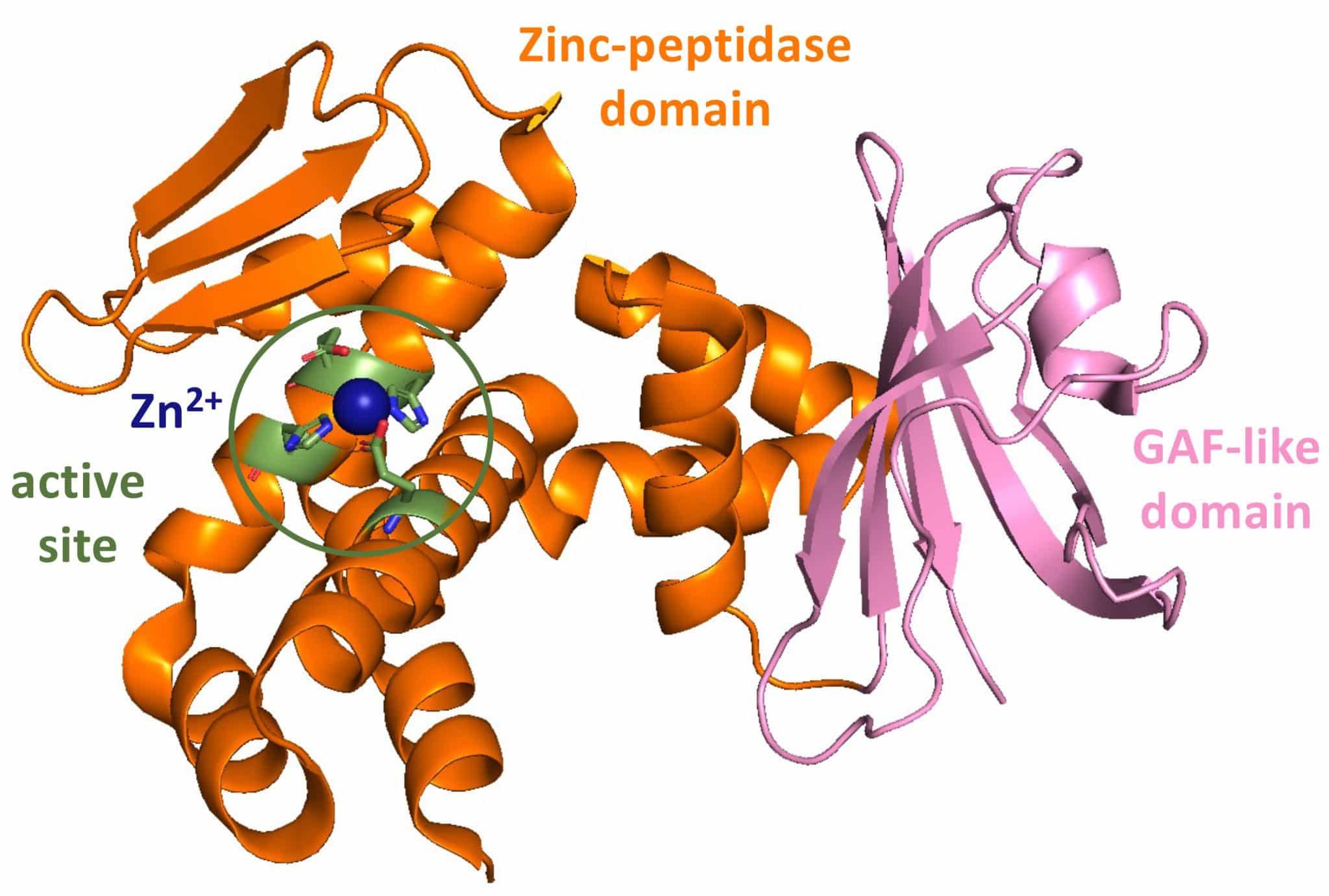
The metallopeptidase IrrE from radiotolerant Deinococcus bacteria (PDB 3DTI): after irradiation or desiccation, IrrE cleaves the repressor DdrO, thereby activating DNA repair genes and ensuring bacterial survival
The mechanism of action is now well established: in response to radiation or desiccation that damages DNA, IrrE is activated and cleaves the DdrO repressor, leading to its inactivation. This step then triggers the expression of DNA repair genes, ensuring cell survival.
Bacterial Homologues of IrrE: New Avenues and Applications
Homologues of IrrE have been identified in numerous bacteria, whether environmental, pathogenic, or used in industry. Studying them could shed light on mechanisms of antibiotic tolerance, modulate the survival of pathogenic microorganisms, or optimize bacterial strains used in stress-prone bioproduction. This discovery highlights the importance of fundamental research in revealing key mechanisms of cellular survival and paves the way for new national and international collaborations involving CEA and CNRS with other partners.
An Inspiring Model, from Fundamental to Applied Science
IrrE perfectly illustrates how the study of a model organism can have a major scientific impact while inspiring innovative approaches for applied microbiology, radiobiology, and industrial biotechnology. This recognition, through the inclusion of the enzyme IrrE in an international reference book, opens new perspectives for research on bacterial stress responses and for the development of scientific collaborations and partnerships.
References
De Groot A.* & Blanchard L. (2025) IrrE peptidase (Deinococcussp.). Handbook of Proteolytic Enzymes. Metallopeptidases. 4th edition, Chapter 84 – pages 587-590.
DOI : 10.1016/B978-0-443-28849-4.00084-9
Bacterial radioresistance: Zinc, a precious metal!
Principal references, highlights and press release
2005 – de Groot A*, Chapon V, Servant P, Christen R, Fischer-Le Saux M., Sommer S., Heulin T. (2005) Deinococcus deserti sp. nov., a gamma-radiation-tolerant bacterium isolated from the Sahara Desert. Int J Syst Evol Microbiol. 55, 2441–2446. DOI: 10.1099/ijs.0.63717-0
2009 – de Groot A*, Dulermo R, Ortet P, Blanchard L, Guérin P, Fernandez B, Vacherie B, Dossat C, Jolivet E, Siguier P, Chandler M, Barakat M, Dedieu A, Barbe V, Heulin T, Sommer S, Achouak W, Armengaud J. (2009) Alliance of proteomics and genomics to unravel the specificities of Sahara bacterium Deinococcus deserti. PLoS Genetics 5(3):e1000434.2009. DOI: 10.1371/journal.pgen.1000434
2009 – Vujičić-Žagar A, Dulermo R, Le Gorrec M, Vannier F, Servant P, Sommer S., de Groot A, Serre L.* (2009) Crystal Structure of the IrrE Protein, a Central Regulator of DNA Damage Repair in Deinococcaceae. J. Mol. Biol. 386, 704–716. DOI: 10.1016/j.jmb.2008.12.062
2014 – Ludanyi M1, Blanchard L.1, Dulermo R, Brandelet G, Bellanger L, Pignol D, Lemaire D, de Groot A* (2014). Radiation response in Deinococcus deserti: IrrE is a metalloprotease that cleaves repressor protein DdrO. Mol. Microbiol. 94(2):434-49. DOI: 10.1111/mmi.12774
Highlight CEA : Comment Deinococcus résiste à tout
2017 – Blanchard L, Guérin P, Roche D, Cruveiller S, Pignol D, Vallenet D, Armengaud J, de Groot A*. (2017) Conservation and diversity of the IrrE/DdrO-controlled radiation response in radiation-resistant Deinococcus bacteria. MicrobiologyOpen 6(4) :e00477. DOI: 10.1002/mbo3.477
2019 – Lim S, Jung J-H, Blanchard L, de Groot A* (2019). Conservation and diversity of radiation and oxidative stress resistance mechanisms in Deinococcus species. FEMS Microbiology Reviews 43(1):19-52. DOI: 10.1093/femsre/fuy037
Press release : Les ressources insoupçonnées de la nature pour résister aux radiations
2019 – de Groot A, Siponen MI, Magerand R, Eugénie N, Martin-Arevalillo R, Doloy J, Lemaire D, Brandelet G, Parcy F, Dumas R, Roche P, Servant P, Confalonieri F, Arnoux P, Pignol D, Blanchard L.* (2019)Crystal structure of the transcriptional repressor DdrO : insight into the metalloprotease/repressor-controlled radiation response in Deinococcus. Nucleic Acids Res. 47(21):11403-11417. DOI: 10.1093/nar/gkz883
Highlight CNRS and CEA : Radiotolérance bactérienne : une régulation haute couture !
2021 – Blanchard L., de Groot A.* (2021) Coexisence of the SOS-dependent and SOS-independent regulation of DNA repair genes in radiation-resistant Deinococcus bacteria. Cells 10, 924. DOI: 10.3390/cells10040924
2021 – Magerand R, Rey P, Blanchard L., de Groot A.* (2021) Redox signalling through zinc activates the radiation response in Deinococcus bacteria. Sci Rep 25;11(1):4528. DOI: 10.1038/s41598-021-84026-x
Highlight CNRS (INSB DR12) : Radiorésistance bactérienne : le zinc, un métal précieux !
Highlight CEA (DRF and BIAM) : La radiorésistance bactérienne s’organise avec le zinc
2026 – Reuzeau A1, Reille O1, Malesinski S, Barré T, Lemaire D, Allemand F, Sibille N, de Groot A*, Blanchard L.* (2026) Radiation-response in Deinococcus bacteria: characterization of the transient IrrE-DdrO heterodimer complex. FEMS Microbes (in press) DOI: 10.1093/femsmc/xtag001