



When Oxygen Precedes Sugar: Another Story of Photosymbiosis

A team from BIAM, in collaboration with the Laboratoire de Chimie Bactérienne (LCB), proposes a new scenario for the origin of photosymbioses. Their work suggests that oxygen produced by photosynthesis, rather than sugars, may constitute the initial advantage of these associations that profoundly transformed the biosphere. Photosymbioses—the intimate associations between a non-photosynthetic organism and a […]
Interview – Winner of the Young Researchers Award

Exploring the potential of magnetotactic bacteria for the medicine of tomorrow Winner of the Young Researchers Award presented by the Aix-Marseille-Provence Metropolis, Lucia Gandarias-Albaina, a postdoctoral researcher at BIAM, has been recognized for the originality and potential applications of her work. At the crossroads of microbiology, biotechnology, and materials science, her research focuses on magnetotactic […]
IrrE, the survival enzyme of radiotolerant Deinococcus bacteria, enters the Pantheon of Peptidases

After twenty years of research on Deinococcus bacteria, renowned for their exceptional resistance to radiation and desiccation, BIAM celebrates an international recognition: the enzyme IrrE, an essential regulator of cellular survival under severe stress, has been included in the world reference book on peptidases. This chapter highlights the importance of fundamental research and opens new perspectives in […]
MTBiocare – the Grand Prix i-PhD

When Biotechnology Reinvents Cancer Diagnosis and Treatment Each year, the Grand Prix i-PhD rewards young scientists whose innovations have the potential to become high-impact start-ups. This year, Sandy Payan, an engineer at BIAM, is among the laureates with MTBiocare, a groundbreaking iron nanoparticle technology that could transform the diagnosis and treatment of solid cancers. Her […]
Inspiring young people to engage with science and environmental issues

BIAM’s Science Mentoring for Success Bringing BIAM’s Science Mentoring to Life in Schools: after a successful first year, BIAM’s Cordée de la Réussite returns for 2025‑2026. Students, teachers, and researchers will work together on hands-on projects exploring biodiversity, microalgae and biofuels, bioremediation, and school greening initiatives. A scientific and civic adventure not to be missed! […]
Nuclear decontamination: a bacterium that captures strontium-90

As part of a French collaboration1, BIAM researchers have just demonstrated the decontamination capabilities of a cyanobacterium: Gloeomargarita lithophora, which captures strontium-90 (90Sr), a radionuclide present in power plant effluents. This discovery opens the way to highly effective, environmentally-friendly bioremediation. Co-discovered several years ago by IMPMC1 in a stromatolite from Lake Alchichica in Mexico, a […]
When daughter cells take flight: thank you, kinase!

Microalgae and biomass BIAM scientists have identified the crucial role of a plant-specific kinase in regulating daughter cell hatching in microalgae. This breakthrough enables better management of cell wall degradation, facilitating the release of daughter cells and biomass production. One of the main challenges in using microalgae to produce fuel is to understand how to […]
Unlocking Plant Resilience: Evolutionary Synergy in Stress Adaptation

A groundbreaking mechanism enabling plants to optimize their photosynthesis has been unveiled by a scientific collaboration led by the BIAM. Remarkably, this discovery involves molecules of bacterial origin, and opens promising avenues for developing agriculture that is more resilient to climate change. Chlorophyll fluorescence images of plants for analysis of photosynthetic activity Photosynthesis, fundamental to […]
Challenge Elan Eco Energies 2023 awards ceremony at the CEA
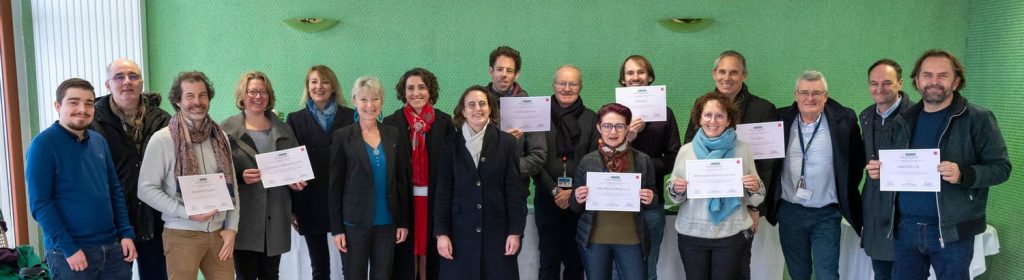
Two innovative projects from BIAM rewarded and supported by CEA On January 23rd, the CEA’s General Management organized the award ceremony for the Elan Eco Energies Challenge 2023. The event took place in the presence of Laurence Piketty, Deputy General Administrator of CEA, Marie-Astrid Ravon-Berenguer, Financial and Programs Director, and Armelle Mesnard, Director of Sustainable […]
When microbiology meets materials science and advanced imaging techniques to better understand symbiotic interactions

A scientific consortium, led by CEA and CNRS researchers of the Institute Biosciences and Biotechnologies of Aix-Marseille (BIAM), have revealed the symbiosis between microbial organisms, whose magnetic properties allow them to navigate collectively in sediments. This work, published in the journal Proceedings of the National Academy of Science, opens the way to apply interdisciplinary approaches […]